

Tech in Fashion
With a rapid rise in AI, are we choosing fashion as a way to escape to the technology-free days of our childhoods?

Looking at the fashion industry, it’s easy for the untrained eye to view endless collections of clothing, shoes, and accessories as excessive and unnecessary. What many fail to understand, at least those not working in the fashion industry in some capacity or passionate about fashion, is the industry has always been deeply intertwined in our culture just like other industries have. I sometimes compare fashion with “chick flicks” because while there are differences between a fun romantic comedy and an action thriller, there is nothing that makes one inherently better than the other. There is more nuance when discussing industries, however, I like to believe that every field, whether it be fashion, finance, etc. has its benefits and place in the world. It is also not lost on me that fields such as finance, economics, engineering, and technology are viewed as more prestigious and important than fashion, and appear to automatically receive the stamp of approval as being non-negotiable because they are typically male-dominated.
History might prove that fashion, or in more historical terms, bodily adornment is a practice engrained in the human brain from birth. Fashion historians claim that while there is a somewhat clear “start-date” to when early humans became interested in adornment through clothing and accessories, it is nearly impossible to pinpoint exactly when fashion as a human concept and art form began because the truth is, that fashion, and art in more general terms, appears to be an inherent human trait.
Early humans weren’t exactly hosting fashion shows and debuting resort collections in Paris and Milan however there is plenty of evidence that early humans expressed themselves through worn objects and practices such as beads, body paint, tattoos, and ritual scarring. Fashion historians narrowed down a list of reasons why humans may have begun these practices and why fashion continues to evolve.
Decoration/adornment
Protection
Modesty
Status
While all four of these points ring true and can be witnessed throughout fashion history over and over again, historians note decoration/adornment as the primary reason why people began wearing clothes as early as 24,000-22,000 BCE.

While this may be obvious to some, fashion’s political and social links are lost on many. You might not care what clothing you wear, but regardless, there is history behind every garment in your closet; a history more than likely driven by political and social movements and changes. Getting dressed in the morning is a political act because you are wearing the culmination of centuries of political and social movements, theories, and world events.
Take Zoot suits for example. Exaggerated shoulder pads and high-waisted ballooned trousers accessorized with long, gleaming watch chains were just about as far as one could get from 1940s white middle-class ideas of respectability. In wearing Zoot suits, Mexican-American and African-American communities had the power to express themselves and protest racial violence in a world that wanted the opposite. Fashion lent marginalized communities a voice and tool to fight back against centuries of injustice, a facet of fashion designers have used throughout history and continue to employ today.
Take mini skirts as another example; A classic staple in every city and party girl’s closet. If not for the gradual rise of hemlines in the U.S. throughout the 1920s and beyond, mini skirts might have never hit the runways and mainstream markets in the 1960s. Hemlines, while a small detail in women’s fashion that may not seem particularly significant today, became a tool for women to express their opposition to the oppressive values endowed upon them by the patriarchy. Rising hemlines introduced more “immodest” ways of dressing that challenged conservative ideals. Suddenly, the difference in school dress codes for girls and boys doesn’t seem so harmless.
More recently, take the Venus T-shirt, designed by Vivienne Westwood and Malcolm McLaren in the 1970s. A garment featuring deconstructed techniques such as loose threads, small holes and tears, and medal hardware like studs, chains, and safety pins, the Venus T-Shirt became a central piece of the Punk movement. An era defined by deconstruction, DIY, unconventional materials, and irregular silhouettes, Punk symbolized a reaction against establishment, communism, capitalism, and high fashion. The fashion industry began to witness a trickle-up pattern as styles worn by everyday people began informing trends across higher levels of the industry instead of the other way around as it had been operating for centuries. Followers of the Punk movement were not just putting on clothing adorned with holes, loose threads, studs, and chains for their satisfaction but to make a statement. To say, “We don’t want to conform to how the world has always been. We want to challenge the status quo to make our lives better.”


This context is to say that fashion has evolved greatly and will continue to evolve as climate change, modern technology, politics, economics, and social justice inherently impact what we wear. Technology has been at the top of my mind as of late when I think of fashion trends correlating to everyday events. Artificial Intelligence has experienced a surge like never before, with everyone having access to Chat GPT to make their grocery lists and plan a marathon training program. Tedious morning emails have suddenly become a breeze and instead of going outside to touch some grass, people are turning to AI for answers to nearly all their questions instead of taking the time to procure an original thought. Although I could likely go on forever about the environmental, cultural, and political implications of AI in our everyday lives and across a vast number of industries, I will be focusing on how a rise in AI is impacting the fashion trends we are currently seeing across runways and in the streets.
With such a vast and rapid rise in AI and technology in general, it appears that many people long for the days of engaging in physical media like reading a book or newspaper instead of doom scrolling or sending snail mail instead of blasting off hundreds of emails every day. Although technology has made life easier in countless ways, and there’s no denying that without the evolution of technology in medical and scientific fields, our society would not nearly be as advanced as it is today, do we need technology in every aspect of our life? With AI on the rise, I think many people have called into question the boundaries we should put in place between ourselves and technology. We are human beings, after all, so when technology is doing everything for us, what are we here for? Technology can’t possibly replace everything, but unfortunately, technology’s simplification of the small and often annoying tasks we must do every day is quite enticing, and so we have begun pushing the limit of what we can have technology, specifically AI do. I fear this will make us dependent on and incapable of functioning without it.
A life without technology calls to mind childhood days spent frolicking in the garden, playing dress-up with my Barbie dolls, and reading in my tree house. Nostalgia for childhood is a theme I continue circling back to in all of my writing because as the world becomes a more difficult place to live both physically and mentally, it is often easier to escape to more golden memories. Of course, the grass is always greener, and life in the present isn’t always so dull. There are small moments every day that put a smile on my face and bring me joy. Romanticizing the little moments that often go overlooked is an extremely helpful and hopeful outlook in a world that places importance on the big, once-in-a-lifetime, newsworthy events.
I don’t think I am the only person feeling this type of way. Recent brand collaborations and designer collections have sparked a resurgence in “early technology” and childhood dressing. By this, I mean bringing pops of color, quirky patterns, and funky silhouettes into our adult wardrobes. By "early technology" I mean the chunky and often cumbersome cellphones, headphones, iPods, and Nintendo DSs we roamed around with. As kids, we may have worn mismatched tops and bottoms and thrown colorful tights on our heads as an accessory and called it a day, but as we get older, society tells us what we should wear and, silently, what we should, clearly, not wear.
San Francisco-based sustainable and community-driven brand Lisa Says Gah! recently collaborated with Polly Pocket, bringing to life the collection of miniature clothing and accessories we had for our dolls as kids. Fit for a colorful spring and summer, campaign models frolicked in an open field clad in candy-colored trousers, cardigans, and dresses, and several pieces in the collection featured Polly Pocket-approved patterns and logos. Our childhood dreams came true! We can now finally dress up as we would have dressed our dolls.


Sandy Liang’s recent Fall/Winter 2025 collection is an ode to days of childhood that we will never experience again. Candy-inspired colors, unlikely color and pattern combinations like bright pink and honeydew melon green and polka dots contrasted against stripes, early 2000s silhouettes such as skirts with leggings and layered tops, and imagery of pastel journals, funky pens, and chunky jewelry paint a clear picture of childhood. Her collection reflects many a child’s bedroom in the early 2000s, sprinkled with trinkets, toys, miniature doll clothes, and candy, and walls carefully curated with posters, magazine adverts, and messy drawings. Liang all but says, “Forget childhood. You can play dress up whenever you want!”
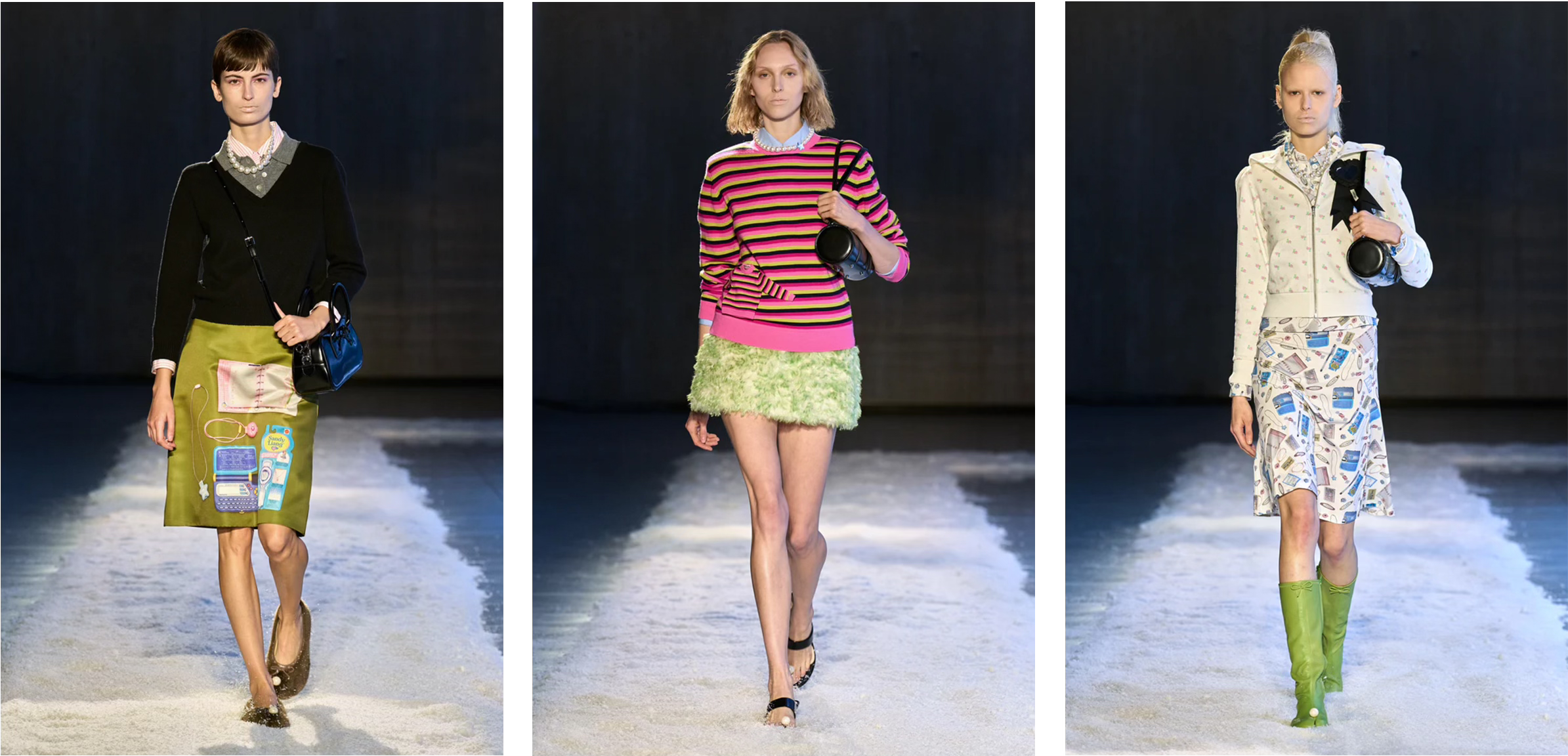
I am admittedly a bit biased because Lisa Says Gah! and Sandy Liang are two of my favorite brands but it can’t be a coincidence that both have recently dropped collections with a similar sense of nostalgia for a technology-free past. What I find most interesting is that both of these brands are for the most part considered womenswear. Sandy Liang, while always featuring whimsical takes on classic designs, typically features clothing fit for working women who want to look sophisticated and polished but with a playful twist. Lisa Says Gah!, on the other hand, is a little more relaxed and geared for the working woman on her day off who owns an art studio and might take a stroll through a farmer’s market before returning home to host a casual dinner with friends and family.
With the collections highlighted above, both brands are offering people a chance to step back into their childhood bedrooms and use fashion as a tunnel through space and time in which to relive days when their biggest concern was how many stickers they could fit on the cover of their journal or what outfit they would wear to school the next day. With Sandy Liang's collection and brand specifically, her pieces are often appropriate work attire and therefore offer a fun twist that could make the annoying aspects of a 9 to 5 desk job a little more enjoyable.
Fashion can be a means to escape, but I don’t think these collections necessarily promote an escape from reality, but rather an escape from the tight grasp of modern technology. To live today doesn’t mean having to rely on technology, and in a way, I think these collections highlight that creativity doesn’t always come from using technology. Or, in other words, humans have always been more capable of creativity than technology has.
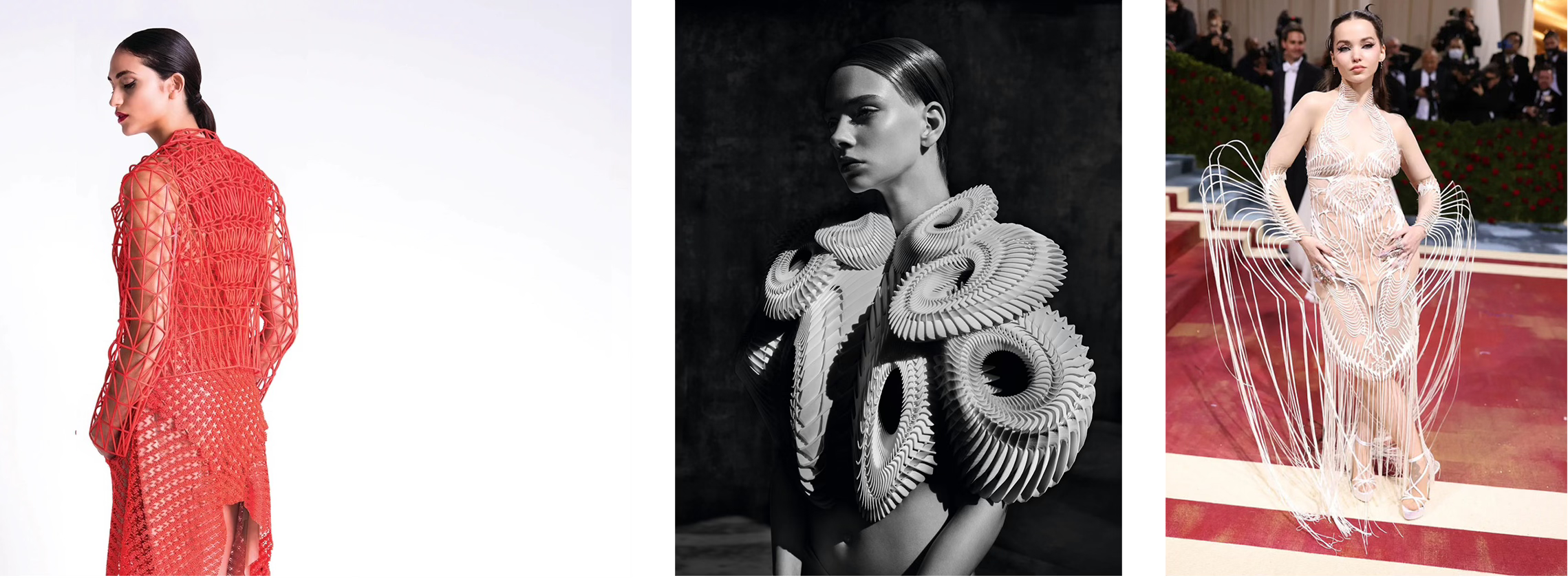
Looking at some runway examples, technology has entered the fashion industry as a tool for more sustainable construction and manufacturing processes. For example, 3D printed designs and textiles used in collections from Danit Peleg and Iris van Herpen have been used as a creative way to recycle materials that otherwise would have ended up in landfills, never to be discovered again. Different AI programs have made it easier for companies and designers to create better sizing, produce more accurate 3D prototypes, and introduce more efficient sourcing and manufacturing practices. While technology is making fashion a more sustainable and efficient industry, these examples showcase that it is the combination of artists’ creativity and technology that make the magic happen, not just technology.
While these technological advancements on the more logistical end of the fashion industry are improving the way we manufacture, design, and distribute clothing, the increased use of technology seems to have trickled down to everyday fashion trends. Headphones and wired earbuds have suddenly become a staple accessory for many, and in a fun twist, iPod minis have found a new home as hair accessories rather than music-listening devices. Tamagotchis dangle on keychains and from accessorized bags, and a mini laptop compact mirror from beauty brand Glossier sold out in just a few days.


Although we are surrounded by the most modern versions of technology, it is the early technology that we choose to accessorize with. Unlike sci-fi films depicting the future as all humans wearing robotic headsets and the latest gadgets, people seem to prefer “vintage” technology. Maybe this is simply because people like the aesthetic of technology from the early 2000s as opposed to the monochromatic and sleek designs of today, or this is a signal of something greater. As fashion trends from the early 2000s come back around, so has the technology. Maybe we are still craving the carefree days of our youth. Maybe we crave the days where our closets weren’t ruled by an algorithm and instead ruled by our wild imaginations. Given the tense political and social climate of today, fashion is once again becoming an important method for expressing ourselves and our values, as well as finding joy and community in difficult times.

if you enjoyed Tech in Fashion, you will love…

The Sex and the City Effect

About a year and a half ago, a dear friend had binge-watched the entirety of Sex and the City, excluding the films and reboot, and was insistent on me watching it because she thought I would love it. I went home later that evening and pressed play on the first episode as I sat to eat dinner. When the credits played and the screen prompted me to play the…
The Met Gala 2025

On the first (very rainy) Monday in May, actors, celebrities, athletes, and artists gathered at The Metropolitan Museum of Art in New York City to celebrate the Costume Institute’s Spring 2025 exhibit: “Superfine: Tailoring Black Style.” This year’s theme celebrates Black style and tailoring and the history of Dandyism. Dandyism emphasizes elegance and …